
As these things go, screaming in the high end of falsetto while babbling incoherently and getting my nose licked by what is possibly the most deadly snake in existence* seems a pretty good place to leave off our narrative.
In the writing biz, it’s what we call a cliffhanger. So called because, back in the days when entertainment was serial, writers would often get to a point where the protagonist was in an impossible situation. One where you knew — just knew — there was no escape. And then end that installment right there.
If they’d done their job right (and, often, they really, really did), the viewers/readers would be desperate to know what happened next. It’s one of the better surefire tricks to bringing back an audience. Provided it’s done well.
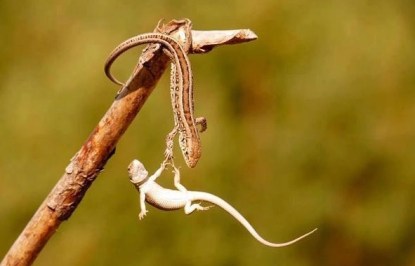
Again, in the early days, this resulted with a protagonist or his trusty Gal Friday, or his feisty Love Interest, or his beautiful Damsel in Distress (are you sensing a pattern here?) actually hanging from an actual cliff. Or stick. See above.
Any Sort Of Delay Can Count As A Cliffhanger
When the next installment opened, the first thing to do was solve the cliffhanger and then move on with the story. Sometimes, though, the next installment would open and it would be torture because the emphasis would have shifted somewhere else, leaving people in suspense about what happened next.
That technique is called burying the lead. Of which, for those of you paying any sort of attention to these posts, you can see an example right here.
I do this to make an important point. Not simply because I’m an inconsiderate bastard who delights in pulling the wings of flies. I mean, I am, but that’s not why I’m doing this right here. It’s just I thought it was about time you and I touched base and talked a bit about craft.
You’ll notice that, in all the bits, pieces and full stories I’ve posted so far, there always has been at least a few moments during which you’ve at least cracked a smile. Or maybe paused for a grin. Or something.
My stories tend to have a bit of humor in them despite my best efforts. (Even pieces I’ve written about surviving a heart attack and another about watching my mother die have funny moments in them.)
I do this for a number of reasons. Many of which I will elucidate below in handy, bulleted form.
Look! I’m Using Bullets
- To point out that, you can have the best blog post ever, but if you don’t bring in more readers, you’re going to be discouraged and quit
- So I could use that picture of the lizard holding up the other lizard, saving his buddy from almost certain doom. I really needed to use that picture.
- Because this is a blog supposedly about learning how to write memoirs, not only as an outlet for memoirs that I am going to write
- And, finally, because I wanted to point out just who we’re laughing at in these last few posts.
See, we all like to laugh at someone else. When someone falls down, or gets hit in the head by a ladder while their friend is turning around, that’s slapstick. That’s funny. (That’s debatable, as not everyone likes The Three Stooges) As comedian/writer/director/author Mel Brooks put it:
Yes, that man is a genius. He also explains why so many memoirs or personal essays that have comedy in them tend to be about the author and also tend to have most of the jokes being played do so at the expense of the author.
We like to laugh at someone else, but (and this is important) then we often will start to feel guilty. We’ll especially start to have bad feelings about the person who’s doing most of the pointing and laughing. To wit: the author.
However, when you’re pointing and laughing at yourself. . . Well, that gives permission to people for them to laugh at you also. And that’s good. We want people to laugh at the things we write that are funny. And, since most of my things tend to be (my attempts at being) funny, that is a good thing.
It also makes my life a lot easier because I do a lot of stupid stuff that makes people laugh at me when I tell them. Funny how that works out, yes? Different kind of funny that.
The Big Finish
So. Now that we’ve got that out of the way. . . Let’s get on with the story.
Where were we? Right. . . The sna–
Oh! I see by the big clock on the wall that we’re out of space.*!*
Until next time, friends. . . Take care of yourselves.

*but probably isn’t.**
** Okay, it definitely isn’t. In fact, as it turns out, the snake’s not even venomous. The above sentence (way above) is an example of what some people call my marked tendency toward exaggeration.***
***By others I’m called a liar, a damn liar and a statistic. That was my only math joke.
*!* Oh, like you didn’t see this one coming from a mile away.

 polish it with your sleeve and then start showing it to anyone who will stop long enough to read. Those lucky readers will get to learn all about the time when you were six and you tried to tiptoe into your parents’ bedroom on Christmas Eve and accidentally saw the (to you) lifesize T-Rex skeleton you wanted more than anything else in the world glowing in the dark, especially the teeth with the glowy thing. And you screamed and screamed until your parents woke up, came to calm you down and say all the right things. But then kept laughing at you about it for the next forty-five years.*
 We didn’t start out afraid to be naked, you know. How many of you have ever had the joyous experience of trying to chase down a gleefully naked child sprinting for anywhere but where their clothing is? If you’ve been near a child, you’ve also been near a naked child. That’s just the way it is.
 suggesting you get metaphorically nude to begin your excursion into memoir. I am not that nicer person.
 and his pal Superman that powered me onto that windowsill. I get the feeling there won’t be much of that sort of inspiration in too many young children after the release of Batman v Superman: Dawn of Justice. This movie features a world that hates Superman and an angry Batman who vows to bring down the horrible alien powerhouse. I don’t see a lot of hope there, nor anything to inspire a child to believe he could fly.
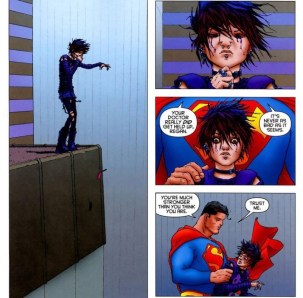 Comic book stories aren’t only about violence. Often times, they play out across the page as modern morality tales. They weren’t always the most complex of moral codes, but they were codes that I, as a young kid, could understand and emulate. For years now, my wife has said that even though I’m not religious in the slightest, I’m the most ethical and moral person she’s ever met. I smile humbly, shuffle my feet a bit and demur about taking all the credit.
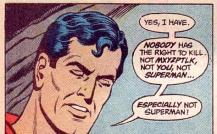 In the movie, the people of Earth are afraid of Superman (after the damage and deaths from the Man of Steel film, all of which can be traced directly back to Superman’s presence on Earth) and he ends up fighting against Batman. I understand that, to many, the idea of a Superman hated by the world is more realistic. I wonder, though. . . Do they realize they’re complaining about realism in a movie about a man who can fly, another man who dresses up as a bat, a super-powered woman who comes from an advanced, hidden civilization, a cyborg and a human living under water?
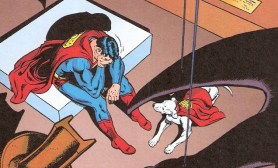 When everyone on Earth would have been demonstrably better off had baby Kal El explosively decompressed somewhere beyond the orbit of Neptune, I think the filmmakers substantially misinterpreted their main character. I and many others left the theater after the Man of Steel movie depressed and tired. I ask myself if I really want to get my hopes up and then have them dashed by an overly violent and cynical movie. I really don’t think the answer is yes.
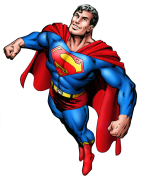 If given a choice, which would I rather have? Leave a movie theater depressed, cynical and ready to hide while the world becomes worse and worse? Or leave the theater uplifted, grateful and wanting to make the world better?



 These stories cover the same memory. Yes, I did once stumble through my darkened house in the darkness of night’s middle. Yes, I did step on a thumbtack. No, I still haven’t figured out what a thumbtack was doing on the floor in the first place since we didn’t have a bulletin board and hadn’t for years.


 That’s all you have to do.

 Writing Life